What is Moderate Astigmatism? Understanding Different Levels of Astigmatism
Posted by: Pepose Vision Institute in Eye Care on April 3, 2026

If you’ve ever left an eye exam with a prescription that included a number for “cylinder,” you’ve been diagnosed with astigmatism.
For many patients, the next question is: how bad is it? Words like “mild,” “moderate,” and “high” come up often in conversations with eye doctors, but what do they actually mean, and more importantly, what does your level of astigmatism mean for your vision and your treatment options?
Whether you’ve just received a new prescription or you’re wondering whether laser eye surgery could help you, understanding the spectrum of astigmatism is a great place to start.
What is Astigmatism, Exactly?
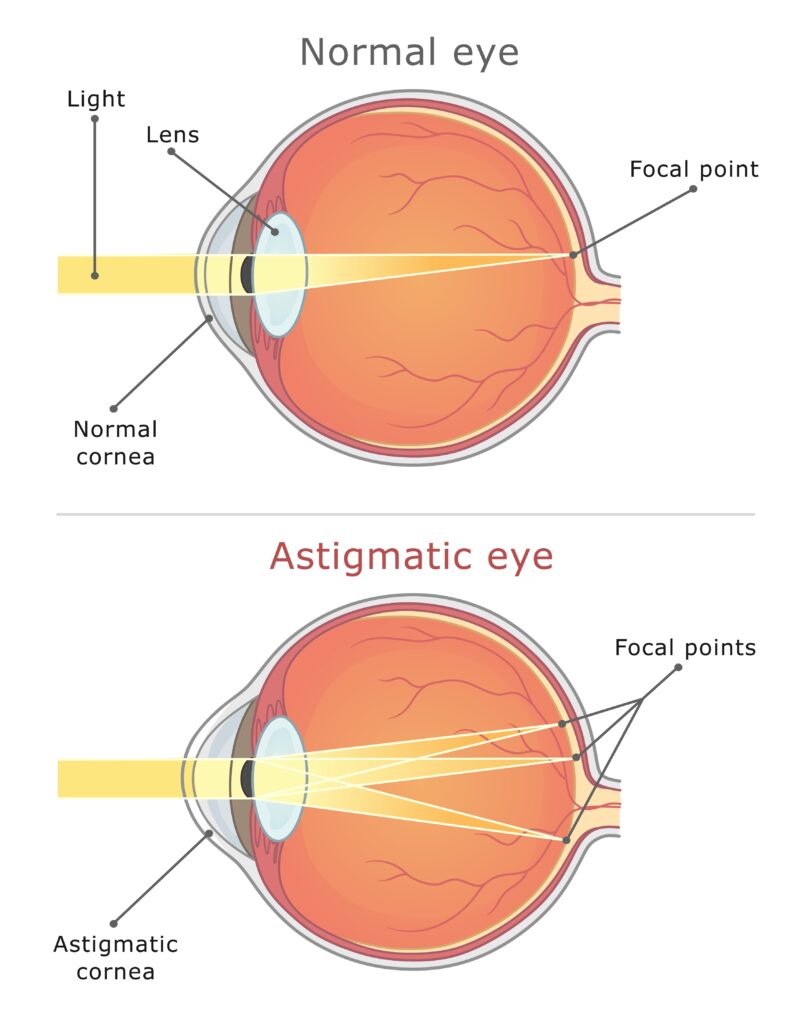
Astigmatism is one of the most common refractive errors in the world, and it occurs when the cornea, which is the clear front surface of your eye, is shaped more like a football than a basketball. Instead of having a perfectly round curve, an astigmatic cornea is slightly oblong, which causes light entering the eye to focus at multiple points rather than a single, sharp point on the retina.
Astigmatism causes blurred or distorted vision at multiple distances, difficulty seeing fine detail, and sometimes eye strain or headaches, especially after prolonged reading or screen time. It often occurs alongside nearsightedness (myopia) or farsightedness (hyperopia), and in some cases, it originates in the eye’s internal lens rather than the cornea itself.
Astigmatism is measured in diopters (D) and is noted as the “cylinder” value on your prescription. This number tells your eye doctor how much correction your eye needs to achieve clear focus.
The Levels of Astigmatism
Mild Astigmatism: Less than 1.00 D
Mild astigmatism is extremely common and often goes unnoticed. Many people with a cylinder correction under 1.00 diopter may not experience significant visual symptoms in everyday life. That said, some individuals, particularly those who spend long hours reading, driving, or working at a computer, may notice subtle blurring or eye fatigue. Mild astigmatism is typically managed easily with glasses or soft toric contact lenses, and it is an excellent candidate for laser vision correction.
Moderate Astigmatism: 1.00 D to 2.00 D
This is where many patients start to notice that something isn’t quite right with their vision. Moderate astigmatism, generally defined as a cylinder measurement between 1.00 and 2.00 diopters, can produce more consistent and noticeable symptoms, including blurry or slightly distorted vision at both near and far distances, eyestrain and headaches (especially in the afternoon or after screen use), trouble with night driving, including halos or starbursts around lights, and squinting to try to clarify vision.
Moderate astigmatism is very treatable. Glasses and toric contact lenses remain highly effective, and many patients in this range are excellent candidates for LASIK eye surgery or other laser vision correction procedures.
High Astigmatism: 2.00 D to 3.00 D

High astigmatism produces more significant visual distortion and almost always requires consistent optical correction to function comfortably. Patients with high astigmatism may struggle with standard soft contact lenses and may be recommended specialty lenses for better clarity and fit.
LASIK can still be an option for many patients in this range, depending on corneal thickness and other anatomical factors. A thorough consultation and corneal mapping at our institute will help determine the best path forward.
Very High (or Severe) Astigmatism: Greater than 3.00 D
Astigmatism above 3.00 diopters is considered severe and typically causes substantial visual impairment without correction. At this level, patients often require specialty contact lenses, such as rigid gas-permeable (RGP) or scleral lenses, for optimal optical clarity. Some cases may be associated with a corneal condition called keratoconus, a progressive thinning and steepening of the cornea that warrants specialized monitoring and care.
Can LASIK Treat Moderate Astigmatism?
Yes, and for most patients with moderate astigmatism, LASIK is a life-changing option. During the procedure, a precise laser reshapes corneal tissue to correct the irregular curvature that causes astigmatism, changing the cornea from that football-like shape to a rounder, basketball-like profile so that light can focus properly on the retina.
At Pepose Vision Institute, we were the first practice in the St. Louis region to offer LASIK, and our surgeons participated in the original FDA clinical trials that brought LASIK to patients nationwide. Today, we use advanced wavefront mapping technology to create a detailed, personalized treatment plan before a single laser pulse is applied. Most patients with moderate astigmatism who qualify for LASIK experience dramatically improved vision, often noticing a difference the very same day as their procedure.
Could You Be a Good Candidate for LASIK?
What if I’m Not a LASIK Candidate?
Not every patient is a candidate for LASIK. However, there are other excellent options for managing moderate astigmatism.

Toric contact lenses are soft lenses designed specifically to correct astigmatism by aligning precisely with the axis of your irregular cornea. Many patients with moderate astigmatism find toric lenses comfortable and effective for daily wear.
Glasses remain a reliable, low-maintenance solution and can be customized with anti-reflective coatings, blue-light filtering, and progressive lenses for patients who also experience presbyopia.
Refractive Lens Exchange (RLE) is an option for patients who may not be ideal LASIK candidates due to thin corneas or higher prescriptions. Refractive Lens Exchange replaces the eye’s natural lens with a premium intraocular lens (IOL) that can correct astigmatism, nearsightedness, farsightedness, and even presbyopia simultaneously.
Astigmatic IOLs (Toric IOLs) are particularly valuable for patients with both cataracts and astigmatism. During cataract surgery, an astigmatic lens implant can correct the refractive error at the same time the cloudy natural lens is removed, often reducing or eliminating the need for glasses afterward.
The team at Pepose Vision Institute is here to help you understand your options and see the world with the clarity you deserve. Schedule a comprehensive eye exam today at one of our two convenient St. Louis area locations.