What Happens During Cataract Surgery?
Posted by: Pepose Vision Institute in Cataracts on July 3, 2026
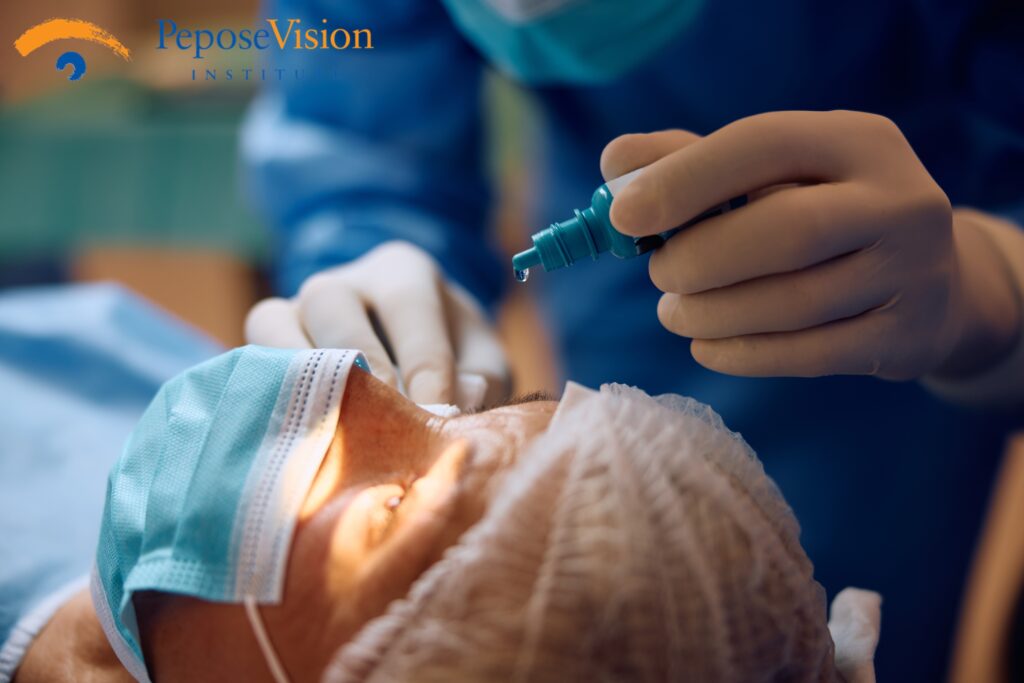
Cataract surgery ranks among the most frequently performed medical procedures, and the vast majority of patients walk out of it seeing more clearly than they have in years. Even so, most people schedule their procedure with only a vague sense of what the day will actually hold.
Knowing the sequence of events, from the measurements taken weeks ahead to the moment you head home for a nap, tends to replace nervousness with confidence. Here is what the process looks like at each stage.
How Your Eye Is Measured Before Cataract Surgery
The work that determines your visual outcome happens well before any incision. A cataract is a clouding of the eye’s natural lens, and cataract surgery replaces that lens with a clear artificial one. The catch is that an artificial lens has a fixed power, so it has to be calculated with real precision for your specific eye. A measurement that is off by a fraction of a millimeter can leave you needing stronger glasses than necessary. That is why the preoperative exam is so thorough.
At Pepose Vision Institute, the eye is measured using a few advanced methods:
- First, with the ARGOS optical biometer, a light-based instrument that maps the length and shape of the eye comfortably and accurately, even when a cataract is dense
- Then, wavefront analysis adds thousands of data points about how light travels through your eye
- Lastly, Orbscan corneal topography evaluates the cornea at more than 8,000 points
These readings feed advanced lens calculations that pin down the exact implant power you need.
Your surgeon reviews all of it with you, answers questions, and discusses which lens fits your eyes and your daily life. By the time surgery day arrives, the plan is already set.
Choosing an IOL for Cataract Surgery
The artificial lens that replaces your cloudy one is called an intraocular lens (IOL), and the type you select determines how you will see afterward. A standard monofocal lens focuses clearly at one distance, usually far away, with reading glasses filling in the rest. Newer designs do considerably more.
At Pepose Vision Institute, we offer a variety of advanced IOLs, including trifocal lenses, which deliver clear vision at near, intermediate, and far ranges, reducing how often patients reach for glasses at all. If you have astigmatism, an astigmatism-correcting lens addresses the irregular curvature of the cornea at the same time the cataract is removed.
We also offer the RxSight Light Adjustable Lens, the only IOL that can be fine-tuned after surgery. The full range of IOL options is worth discussing in detail, since the right choice depends on your eyes, your hobbies, and how much you want to depend on glasses.
The Cataract Procedure Step by Step
The operation itself is quick, often finished in well under half an hour.
Making the Incision
Once your eye is numb, the surgeon creates a tiny incision at the edge of the cornea. The incision is so small that, in most cases, no stitches are needed afterward, which means less irritation and a faster recovery.
Removing the Cloudy Lens
Through that opening, the surgeon uses ultrasound energy to gently break up the cloudy natural lens into fragments, then removes them. This step clears out the cataract entirely.
Inserting the New Lens
With the cloudy material gone, the folded IOL is inserted through the same micro-incision and positioned behind the iris, the colored part of the eye. The lens then unfolds into place, where it stays permanently. Because it is positioned exactly where your natural lens used to sit, it focuses incoming light onto the retina the way a healthy lens should.
After the IOL is properly positioned, the procedure is complete.
Many patients are surprised to learn that the two eyes are not done on the same day. Each eye is treated about two weeks apart, allowing the first eye to begin healing and giving your surgeon a chance to confirm the outcome before scheduling the second.
Is Cataract Surgery Painful?
Most patients are surprised by how little they feel during the operation. Early cataract surgery once required general anesthesia and a hospital stay, and later techniques relied on an injection placed behind the eye. Pepose Vision Institute uses topical anesthesia, which numbs the eye with drops. You stay awake, but calm and comfortable throughout.
When Should You Have Cataract Surgery?
Timing is a personal decision rather than a fixed deadline. Cataracts usually develop slowly, and the right moment for surgery is when cloudy vision starts interfering with the things you care about: reading, driving at night, or seeing a grandchild’s face clearly.
A comprehensive eye exam is the only way to confirm a diagnosis and rule out other causes. The experienced eye care team at Pepose Vision Institute, which has completed more than 40,000 cataract surgeries, can walk you through whether surgery makes sense for you and which lens would serve you best.
Want to gauge whether your symptoms line up with cataract development?
Wondering what your own cataract surgery would involve? Schedule an appointment at Pepose Vision Institute in St. Louis, MO, today!