What Is the Light Adjustable Lens and How Does It Work?
Posted by: Pepose Vision Institute in Cataracts on August 7, 2026

With every traditional cataract lens, your surgeon has to select its power before your procedure based on measurements taken while your eye still has its cataract. Once that lens is in place, the prescription is set. If the healed result lands slightly off from your vision goals, your options are limited to glasses or a second procedure.
The RxSight Light Adjustable Lens changes that equation. It is the first and only intraocular lens (IOL) that can be customized after cataract surgery, once your eye has healed and your surgeon can see exactly how you see.
Instead of committing to a single power on the day of surgery, you and your doctor refine your vision over the following weeks until it matches how you actually want to live.
Keep reading to learn more about the Light Adjustable Lens and why it can be a great option for many patients wanting more personalization of their vision after cataract surgery or RLE.
What Makes the Light Adjustable Lens Different?
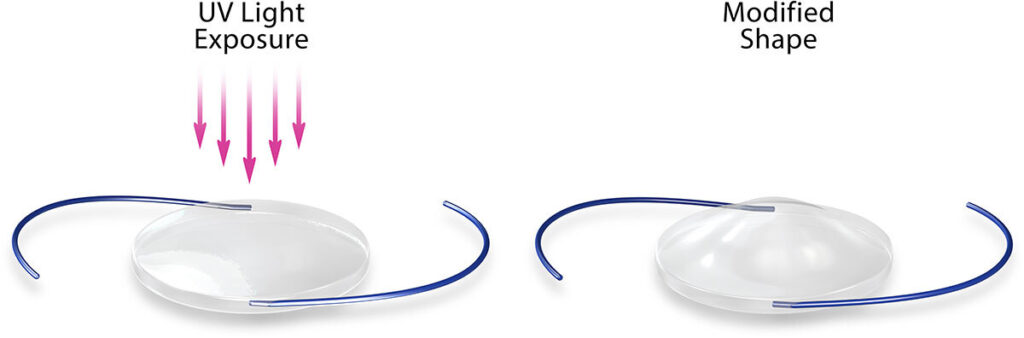
Standard IOLs are made of materials that hold a fixed shape and power for life. That predictability is a strength, but it also means the lens cannot correct for the small variations that can occur during healing, like a touch of residual astigmatism or a prescription that settles a hair away from the target.
The Light Adjustable Lens is built from a special photosensitive material developed by a Nobel Prize-winning scientist. This material responds to ultraviolet (UV) light. When your doctor applies a precise pattern of UV light to the lens, its shape and focusing power physically change inside your eye. That single property is what allows your prescription to be dialed in after the fact, rather than guessed at beforehand.
How the Light Adjustable Lens Works
The process unfolds in three distinct stages, and only the first one happens in the operating room.
Step One: Cataract Surgery and Lens Implantation
The surgery itself is no different from a standard cataract procedure. Your surgeon removes the cloudy natural lens and implants the Light Adjustable Lens in its place. If you have had cataract surgery described to you before, this part will sound familiar, because the technique, the incision, and the recovery are the same. The difference is entirely in what the lens can do afterward.
Step Two: The Light Treatments
Once your eye has healed, usually a couple of weeks after surgery, the customization begins. You return to the office for a series of non-invasive light treatments delivered through a device called the Light Delivery Device (LDD). Each treatment is quick, taking roughly 60 to 90 seconds, and treatments are spaced a few days apart.
Most patients need two to four treatments over one to two weeks to reach their vision goals. Each treatment reshapes the lens slightly, and the change takes hold over about 48 hours.
Step Three: Locking in Your Prescription
When your vision reaches the point you and your doctor are happy with, a final light treatment locks the lens in place. This step permanently sets the prescription so it will not shift with future light exposure. After the lock-in treatment, the vision you have adjusted into the lens is yours to keep.
How Does Previewing and Customizing Your Vision Work?
Here is where the Light Adjustable Lens does something no other IOL can. Before each adjustment becomes permanent, you can preview the prescription. You get to compare how the world looks after each adjustment and tell your doctor which one feels right for how you read, drive, and work. Most vision correction asks you to trust the math and hope the outcome fits. This lens lets you test-drive the result first.
Who Is a Good Candidate for the LAL?

The Light Adjustable Lens tends to suit patients who prioritize precision and are willing to commit to the post-surgery adjustment schedule. Because the lens can correct astigmatism along with nearsightedness and farsightedness, it appeals to people who want to reduce their dependence on glasses as much as possible.
There are some limits worth knowing. The photosensitive material reacts to UV light, so you will need to wear protective UV-blocking glasses between surgery and the final lock-in treatment to keep sunlight from altering the lens prematurely. Patients who cannot reliably follow that requirement may not be good candidates. Certain medications that affect the retina or increase UV sensitivity, along with a history of specific eye infections, can also rule out candidacy.
Your surgeon at Pepose Vision Institute will determine whether the lens is a good option for you during a thorough evaluation.
How the Light Adjustable Lens Compares to Other Lens Options
The Light Adjustable Lens is one of several premium lenses in a broad range of advanced intraocular lenses available today.
A PanOptix trifocal lens, for example, delivers clear vision at near, intermediate, and distance ranges through a fixed multifocal design. The Light Adjustable Lens trades that fixed design for the flexibility of post-operative tuning.

The lens is not limited to cataract patients, either. It can also be used in refractive lens exchange, a procedure that replaces the natural lens before cataracts develop, often for patients in their late 40s and 50s who are tired of readers or feel their LASIK results have faded. As you compare choices, weigh your daily activities against each lens design, and ask your eye doctor questions to clear up much of the terminology so you can have a full understanding of the options.
As a nationally recognized leader in cataract care, the specialists at Pepose Vision Institute can explain how the Light Adjustable Lens and other premium IOLs might perform based on your unique eyes and vision goals.
Wondering if the Light Adjustable Lens could give you the most personalized vision outcome possible? Schedule an appointment at Pepose Vision Institute in St. Louis, MO.